
Construction Truck Cab Mounts by Cab Type
It is 6:45 a.m. and your foreman is pulling out of the yard in a crew cab loaded with three phones, a tablet running the ELD, and a GPS unit wedged against the windshield with a suction cup that gave up somewhere around mile 40 yesterday. Meanwhile, the dump truck driver is navigating a tight residential street with his phone sitting loose on the seat. Neither setup is working. The problem is not the devices. It is that every cab type creates a different mounting problem, and a one-size solution rarely fits all of them.


Quick answer: Match your mount to your cab. Regular cabs do well with cup-holder or wedge mounts. Crew cabs and vans benefit from seat-rail or drill-base AMPS mounts. Service bodies and dump trucks often need a fixed drill-base or rail solution. The sections below break it down by cab type.
Why Cab Type Changes Everything
A standard pickup cab has a narrow console, limited dash real estate, and one cup holder that is already occupied by coffee. A crew cab adds rear-seat passengers, longer center consoles, and sometimes a second device for a co-pilot or inspector. A service body truck, as defined by vocational body builders like Knapheide and Monroe Truck Equipment, often has a stripped or upfitted cab interior where factory dash trim is already modified. Dump trucks and vans present their own geometry entirely.
The FMCSA requires that a portable ELD be mounted in a fixed position and visible to the driver from the normal seated position. That rule alone eliminates the loose-on-the-seat approach for any commercial vehicle running hours-of-service logs. And the FMCSA mobile phone restrictions reinforce that hands-free, close-proximity placement is the standard for commercial drivers. Better mounting improves visibility and access. It does not support compliance on its own, but it removes the reaching and fumbling that creates risk.
Cab-Type Decision Matrix
Use this table to identify the mounting approach that fits your fleet before you order anything.
| Cab Type | Common Problem | Best Mount Class | Notes |
|---|---|---|---|
| Regular cab pickup | Narrow console, one cup holder | Cup-holder or wedge mount | No-drill; easy to swap between trucks |
| Crew cab pickup | Long console, multiple devices | Seat-rail or drill-base AMPS | Seat-rail keeps tablet out of driver sightline |
| Service body truck | Modified or stripped dash trim | Drill-base AMPS mount | AMPS pattern works across upfitted surfaces |
| Dump truck | High cab, vibration, limited console | Drill-base AMPS or seat-rail | Fixed base handles vibration better than suction |
| Cargo or transit van | Flat dash, no center console | Suction or drill-base dash mount | Suction works on flat glass; drill-base for permanent installs |
| Mixed fleet | Different cabs, same device | AMPS adapter plus modular base | One head unit, swap bases between vehicles |
Mounting Approaches and Where Each One Fits
Cup-holder mounts are the fastest no-drill solution for regular cab pickups and any truck where the console cup holder is accessible and stable. The iBOLT xProDock Bizmount Console Phone Cup Holder Mount ($64.95) fits cup holders from 2.5 to 3.5 inches in diameter, uses dual ball joints for full 360-degree adjustment, and holds phones up to 3.7 inches wide including cases. It installs without tools, which matters when you are moving a mount between three trucks on the same job. ProClip-style vehicle-specific mounts are a clean alternative for a single-model fleet where you want a factory-fit look, but they are less practical when your yard has four different truck models.

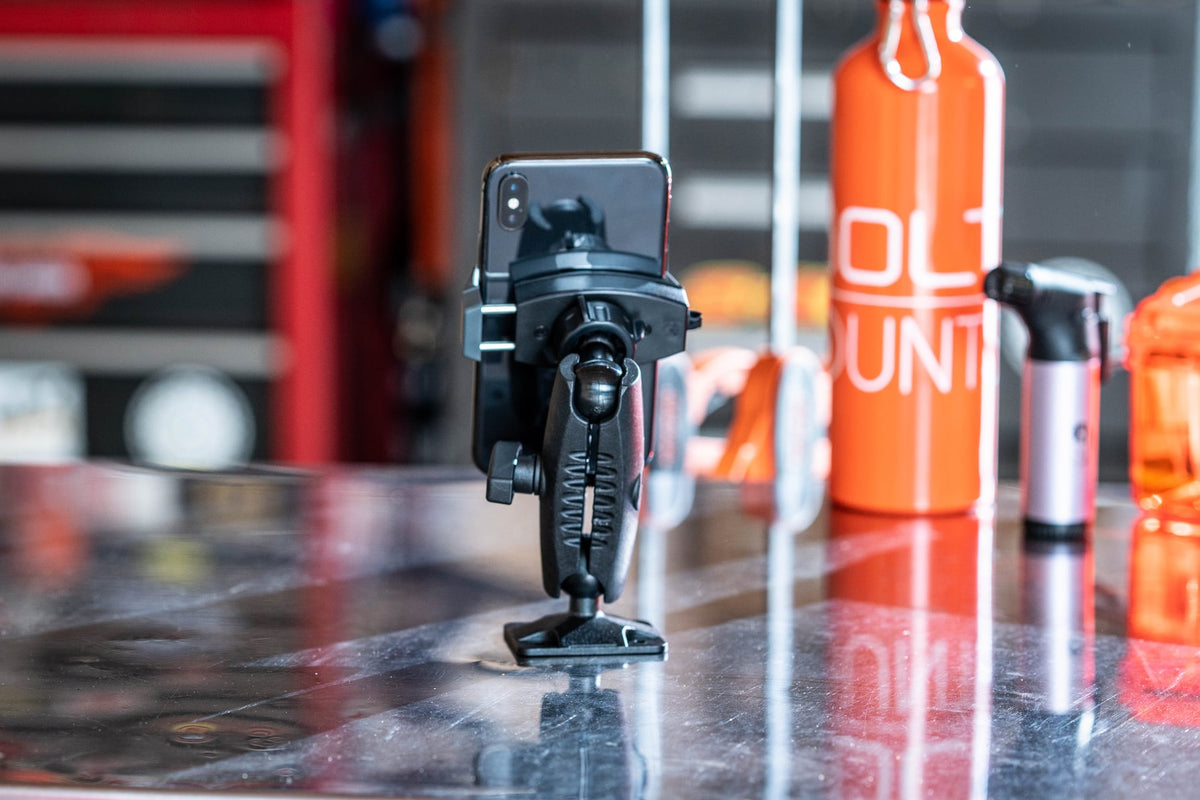
Drill-base AMPS mounts are the right call for service body trucks, dump trucks, and any cab where the dash or console has already been modified by an upfitter. The industry-standard AMPS four-hole pattern (30mm x 38mm spacing) means the base stays put regardless of vibration, and the head unit can be swapped or upgraded without re-drilling. The iBOLT TabDock Bizmount AMPS Heavy-Duty Tablet Mount ($29.95) uses dual 25mm ball joints and a four-point grip system that holds 7-to-11-inch tablets, including ELD devices in thick cases. RAM-style ball systems cover similar ground and are a solid choice for heavy-duty custom builds, but can be more hardware than a straightforward phone-or-tablet install requires.
Watch: iBOLT TabDock BizMount AMPS (IBBZ-33921)
See the standard TabDock holder, four-prong adapter, 25 mm BizMount arm, and AMPS drill base being assembled and adjusted.
Watch the short vertical demo (20 seconds)

iBOLT™ TabDock™ Bizmount™ AMPs - $29.95
Seat-rail mounts solve the crew cab and dump truck problem where the driver needs a tablet visible from the seated position without blocking the dash or windshield. The iBOLT LockPro FlexPro Heavy Duty Locking Tablet Seat Rail Mount ($159.95) attaches to the passenger seat rail, uses an 18-inch aluminum gooseneck for positioning, and includes a metal locking cradle with keys to prevent theft or accidental drops. For fleets running ELD compliance on tablets, this placement keeps the screen in the driver's sightline without occupying dash or console space. Bulletpoint-style dash rails are strong for specific truck interiors like certain Ford and GM models, but they are model-specific and do not transfer easily across a mixed fleet.

AMPS adapter plates are the connective tissue for mixed fleets. If your crew cab uses a drill-base and your service truck uses a different ball-socket system, the iBOLT 25mm Metal AMPS Adapter Plate ($12.95) bridges the gap. It is machined aluminum with a rubber-coated ball and works with any 25mm or AMPS-compatible system. One head unit, multiple bases, no redundant hardware purchases across the fleet.

Putting It Together for Your Fleet
The practical approach for a mixed construction fleet is to standardize on one device-holding head unit and vary the base by cab type. Cup-holder base for the regular cab pickups. Drill-base AMPS for the service bodies and dump trucks. Seat-rail for the crew cabs running tablets. AMPS adapter plates to connect any legacy hardware already in the yard. iBOLT's 300-plus modular parts mean you are not starting over when a truck gets replaced or a new body type joins the fleet.
Explore the full iBOLT lineup and see which setup fits your station at iboltmounts.com.
Frequently Asked Questions
Can I use a suction mount in a dump truck or service body cab?
Suction mounts work on flat glass surfaces but are not ideal for high-vibration cabs. A drill-base AMPS mount or seat-rail mount holds more reliably in those environments.
Does FMCSA require a specific mount type for ELD tablets?
FMCSA requires the ELD to be mounted in a fixed position and visible from the normal seated position. The mount type is not specified, but it must stay fixed while driving.
What is the advantage of AMPS compatibility across a mixed fleet?
AMPS is an industry-standard four-hole pattern, so one head unit can move between different bases in different vehicles without buying new hardware for each cab type.
Are vehicle-specific mounts like ProClip a better choice than modular mounts?
Vehicle-specific mounts offer a clean, no-drill fit for a single truck model. Modular AMPS-based systems are more practical when your fleet includes multiple cab types or changes vehicles regularly.


Leave a comment
This site is protected by hCaptcha and the hCaptcha Privacy Policy and Terms of Service apply.