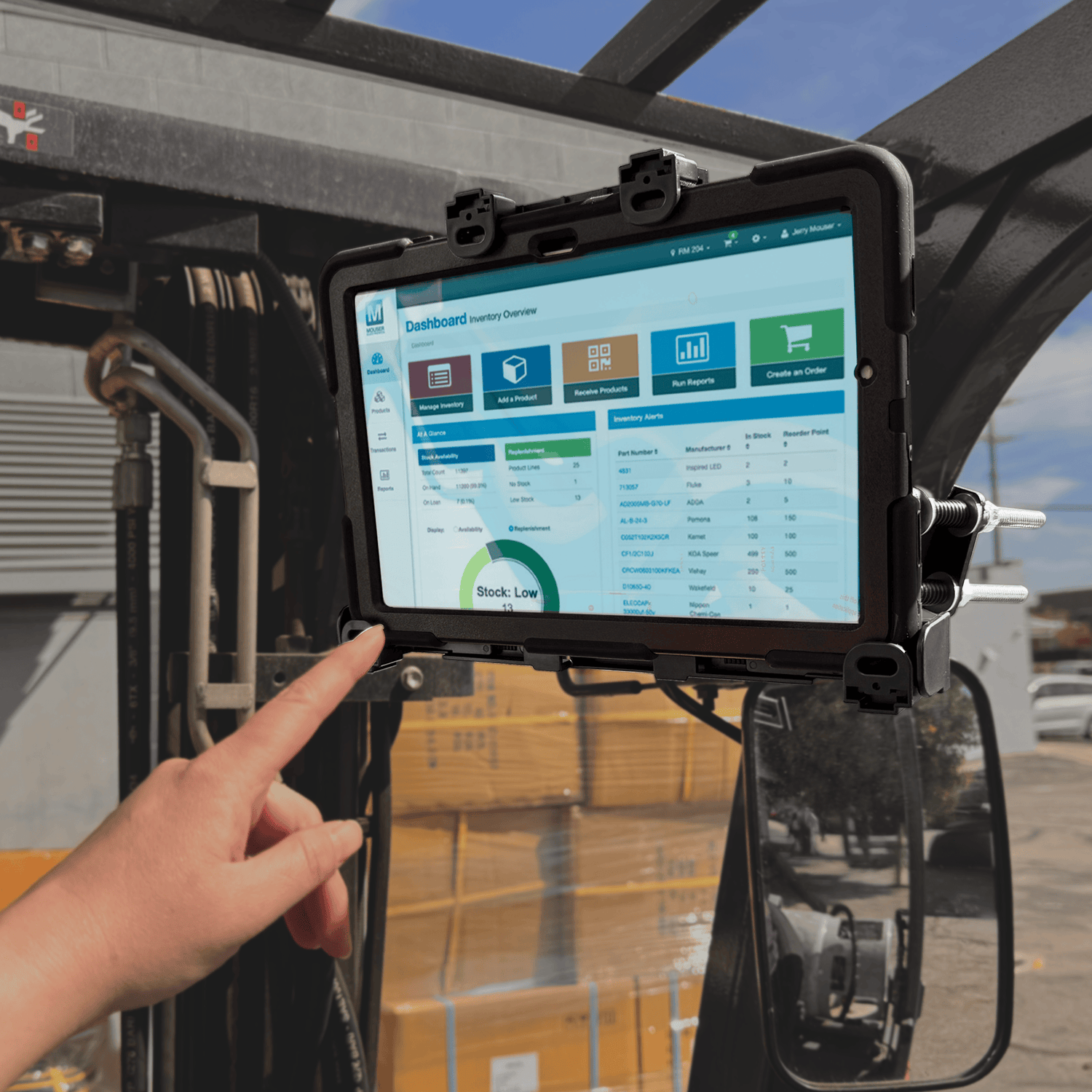
Your warehouse team just went through their third set of tablet mounts this year. The latest batch lasted six weeks on the forklifts before the constant vibration loosened the joints and cracked the holders. Meanwhile, your WMS rollout is stalled because operators can't rely on their mounted tablets staying put during a full shift. Sound familiar?
When warehouse managers face this mounting crisis, two names consistently surface: RAM Mounts and iBOLT. Both offer forklift tablet solutions, but they approach the warehouse environment from completely different angles. RAM brings a massive ecosystem of components and device-specific solutions. iBOLT focuses on purpose-built warehouse standards that handle the operational realities of material handling environments.
This comparison cuts through the marketing to help you choose the right mounting system for your warehouse operation, fleet standardization needs, and long-term maintenance requirements.
The Warehouse Mounting Challenge
Forklift mounting isn't just about holding a tablet. Your mounts face constant vibration over 8-12 hour shifts, temperature swings from freezer zones to loading docks, and the inevitable impacts from pallets, boxes, and tight maneuvering. Standard consumer mounts fail within weeks because they're designed for cars, not Class I-VII forklifts.
Warehouse managers tell us they "go through 3-4 cheap mounts a year per forklift" and "need something that can take a beating." The real cost isn't the mount replacement - it's the downtime when operators can't access their WMS, the safety risks from loose tablets, and the maintenance time spent swapping failed hardware.
Your mounting system also needs to support shift changes, fleet maintenance, cable routing for charging, and OSHA visibility requirements. A mount that works perfectly on one forklift but requires different hardware on another creates operational complexity your team doesn't need.
RAM Mounts: The Ecosystem Approach
RAM Mounts built their reputation on modularity and breadth. Their catalog includes hundreds of components: vehicle-specific bases, telescoping poles, double swing arms, device-specific holders like Tab-Tite and Tab-Lock, and the X-Grip universal system. For forklifts, RAM typically combines a no-drill base, articulating arm, and tablet holder into complete kits.
RAM's genuine strengths include their lifetime warranty on components, extensive device compatibility through holders like the Tab-Tite series, and the ability to build custom configurations for unusual mounting scenarios. Their GDS docking systems offer charging integration, and their modular design means you can swap components as needs change.
The ecosystem approach works well when you need maximum flexibility or have diverse device requirements across your operation. RAM's vehicle-specific bases can accommodate different forklift models without drilling, and their range of arm lengths handles various cab configurations.
iBOLT: Purpose-Built for Operations
iBOLT takes a different approach. Instead of building a massive component ecosystem, iBOLT designs complete mounting systems specifically for warehouse and fleet environments. Their forklift mounts integrate the base, arm, and holder into purpose-built units that handle operational requirements from day one.
The

iBOLT LockPro™ IncrediBOLT™ 360 Pillar Mount- Heavy Duty Forklift Tablet Mount for Warehouse Vehicles and 7-10 inch Tablets - $169.95
iBOLT's operational focus shows in details like cable routing channels, shift-change lockability, and AMPS pattern compatibility for accessories. The
includes the IncrediBOLT 360 system that maintains tablet security while allowing full rotation for different viewing angles during picking operations.
For fleet standardization, iBOLT's approach simplifies procurement and maintenance. The

iBOLT TabDock Bizmount Pillar Mount- Heavy Duty Forklift Tablet Mount for Warehouse Vehicles and 7-10 inch Tablets - $74.95
Head-to-Head Comparison
| Criteria | RAM Mounts | iBOLT |
|---|---|---|
| Component Ecosystem | Hundreds of modular components, extensive customization options | Complete integrated systems, fewer components to manage |
| Device Compatibility | Device-specific holders (Tab-Tite, Tab-Lock) plus universal options | Universal 7-10" tablet compatibility, AMPS accessory support |
| Vibration Handling | Depends on component selection and assembly quality | Engineered as complete systems for warehouse vibration |
| Fleet Standardization | Requires component management across different configurations | Single part numbers work across multiple forklift models |
| Installation Complexity | Multiple components require assembly and adjustment | Pre-integrated systems with simplified installation |
| Locking Security | Available through specific components like Tab-Lock | Integrated locking in warehouse-focused models |
| Warranty | Lifetime warranty on components | Standard product warranty |
| Price Range | Complete forklift kits: $200-400+ | Complete forklift systems: $75-170 |
Use Case Fit Analysis
RAM Mounts excels when you need maximum flexibility or have complex device requirements. If your warehouse runs different tablet models across departments, RAM's device-specific holders ensure proper fit and charging access. Their modular system also handles unusual mounting scenarios, like specialized attachments for reach trucks or order pickers.
The ecosystem approach benefits operations with dedicated IT support who can manage component inventory and handle custom configurations. RAM's lifetime warranty provides long-term value if you're willing to invest in their complete system and maintain component inventory.
iBOLT fits operations that prioritize operational simplicity and fleet standardization. If you're rolling out WMS tablets across 50+ forklifts and need consistent mounting that maintenance teams can install and service quickly, iBOLT's integrated approach reduces complexity.
The purpose-built design handles warehouse-specific requirements like shift-change security, cable routing for charging, and vibration resistance over full shifts. iBOLT works particularly well for operations that want to standardize on universal tablet compatibility rather than managing device-specific holders.
Fleet Maintenance Considerations
Your mounting choice affects long-term fleet maintenance. RAM's modular system means you can replace individual components when they wear out, but it also means tracking multiple part numbers and ensuring technicians have the right components for each configuration.
iBOLT's integrated approach simplifies maintenance inventory. One part number covers the complete mounting system, and universal tablet compatibility means you don't need device-specific replacement holders. This approach reduces maintenance complexity but means replacing the entire mount when components fail.
Consider your maintenance team's capabilities and inventory management systems. Operations with strong parts management may benefit from RAM's modularity, while lean maintenance teams often prefer iBOLT's simplified approach.
Installation and Standardization
Installation complexity varies significantly between approaches. RAM's complete forklift kits require assembling multiple components, adjusting arm positions, and ensuring proper tightening across multiple connection points. The flexibility comes with installation time and the potential for inconsistent setups across your fleet.
iBOLT's integrated systems install as complete units with fewer adjustment points. This approach supports consistent installations across different forklift models and reduces the variation between individual setups. For fleet rollouts, this consistency helps ensure operators have similar tablet positioning regardless of which forklift they're operating.
Frequently Asked Questions
Q: Can I use AMPS accessories with both mounting systems?
A: Yes, both RAM and iBOLT support AMPS pattern accessories. RAM uses AMPS throughout their modular system, while iBOLT integrates AMPS compatibility into their complete mounting systems.
Q: Which system handles forklift vibration better?
A: iBOLT designs their complete systems specifically for warehouse vibration, while RAM's performance depends on component selection and assembly quality. Properly configured RAM systems can handle vibration well, but require more attention to component choice and installation.
Q: Do I need different mounts for different forklift models?
A: RAM offers vehicle-specific bases for different forklift models, while iBOLT's pillar mounts work across most standard forklift configurations. Your choice depends on whether you prefer vehicle-specific optimization or universal compatibility.
Q: Which system is better for shift-change security?
A: iBOLT integrates locking into their warehouse-focused mounts like the LockPro series. RAM offers locking through specific components like Tab-Lock holders, but requires selecting and configuring these components.
Q: How do charging requirements affect the choice?
A: Both systems accommodate charging cables, but through different approaches. RAM's GDS docking systems provide integrated charging, while iBOLT includes cable routing in their mount designs. Consider whether you need docking-style charging or prefer cable flexibility.
Recommendation by Operation Type
Choose RAM Mounts if: You need maximum flexibility, run diverse device types, have dedicated IT support for component management, value lifetime warranty coverage, or require specialized mounting for unique forklift configurations. RAM works well for operations that can invest time in system configuration and component inventory management.
Choose iBOLT if: You prioritize fleet standardization, want simplified maintenance, need purpose-built warehouse durability, or prefer integrated solutions over modular systems. iBOLT fits operations that want operational simplicity and consistent mounting across their fleet without managing multiple component types.
The choice ultimately depends on your operational priorities. RAM's ecosystem provides maximum flexibility at the cost of complexity. iBOLT's integrated approach provides operational simplicity with purpose-built warehouse focus. Both can handle forklift mounting successfully when matched to the right operational requirements.

Leave a comment
This site is protected by hCaptcha and the hCaptcha Privacy Policy and Terms of Service apply.