Phone Clamp Mounts: Clips, Clamps, or Fixed? How to Choose
Problem proposition: Buyers searching for a phone holder with clip or clamp often waste money on the wrong mount type; this guide clarifies the differences between temporary clips, heavy-duty clamps, and fixed mounts so you can buy the right system the first time.
Featured product links: iBOLT Moto-Vise™ IncrediBOLT™ 360 Heavy Duty Phone Clamp / Handlebar / Rail Mount, iBOLT Moto-Vise™ IncrediBOLT™ Heavy Duty Phone Clamp / Handlebar / Rail Mount
If you have ever searched for a phone holder with clip or a phone clamp and ended up staring at dozens of options that all look roughly the same, you are not alone. The terminology gets blurry fast. Clip mounts, clamp mounts, handlebar mounts, rail mounts, fixed mounts: they all grip your phone, but they solve very different problems. Buy the wrong one and you are either dealing with a device that vibrates loose on the trail or a permanent install you did not need.
This guide breaks down the three main categories, explains what each one is actually built for, and points you toward the right iBOLT system for your specific situation.
Clip Mounts: Fast, Light, and Limited
A phone holder with clip is exactly what it sounds like: a spring-loaded or friction-based holder that clips onto a surface with minimal hardware. These are popular for car vents, bike handlebars with thin tubing, and desk edges where you only need the phone up for a short session.
The trade-off is holding power. Clip mounts rely on light clamping pressure, which works fine on a smooth commute but becomes a liability on rough terrain, during high-vibration activities, or anywhere the phone needs to stay locked in place for hours at a time. If your use case involves a kayak, an off-road vehicle, a motorcycle, or a workstation where the phone is a primary tool, a clip mount is not the right foundation.
Heavy-Duty Clamp Mounts: Built for Real Conditions
A true phone clamp mount goes further than a clip. It uses a mechanical gripping system, often spring-loaded with rubberized contact points, that holds the device against vibration, lateral movement, and impact. The mount itself attaches to a rail, handlebar, or pole with a dedicated clamp mechanism rather than a friction clip.
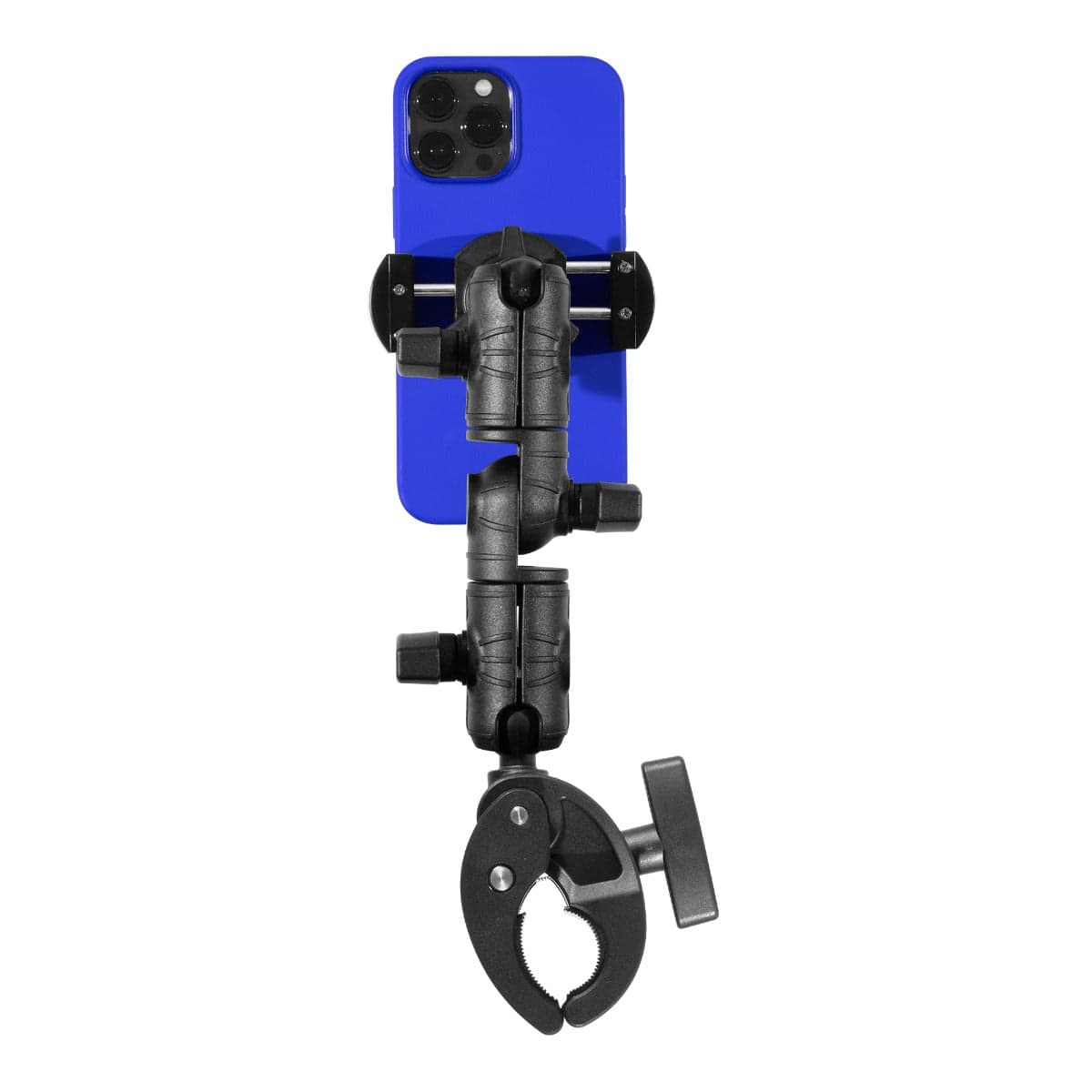
This is the category where iBOLT's Moto-Vise lineup lives. The iBOLT Moto-Vise™ IncrediBOLT™ Heavy Duty Phone Clamp / Handlebar / Rail Mount uses a spring-loaded grip designed to hold your phone securely across outdoor activities including kayaking, fishing, and off-roading. It mounts to handlebars and rails, making it a practical handlebar mount phone solution for cyclists, motorcyclists, and anyone working from a vehicle or equipment rail.

iBOLT Moto-Vise™ IncrediBOLT™ Heavy Duty Phone Clamp / Handlebar / Rail Mount - $64.95
If you need that same holding power with full 360-degree rotation built in, the iBOLT Moto-Vise™ IncrediBOLT™ 360 Heavy Duty Phone Clamp / Handlebar / Rail Mount adds a rotating head so you can dial in portrait or landscape orientation without removing the mount from the bar. Both systems use the same rugged construction; the 360 version gives you more viewing flexibility when your mounting position is fixed.

iBOLT Moto-Vise™ IncrediBOLT™ 360 Heavy Duty Phone Clamp / Handlebar / Rail Mount - $72.95
Fixed Mounts: Permanent Installs for Permanent Needs
Fixed mounts involve drilling, adhesive bases, or dedicated hardware that stays in place. They are the right answer when the device lives in one spot indefinitely, such as a fleet vehicle, a kiosk counter, a warehouse cart, or a workstation where the phone functions as a dedicated tool rather than a personal device you carry in and out.
Fixed systems often use standardized hole patterns. The AMPS four-hole pattern is common in vehicle and industrial mounting; VESA 75x75mm and 100x100mm patterns appear on monitor arms and display mounts. These are not interchangeable even though both use four holes, so measure your existing hardware before assuming compatibility. If you are building a fixed setup from scratch, knowing whether your arm uses a 17mm ball, a 25mm ball, or a 38mm ball matters because your phone holder, tablet clamp, or camera mount needs to match that socket size.
For most personal and semi-professional use cases, a heavy-duty clamp mount like the Moto-Vise line gives you the stability of a fixed install without the commitment. You can move it between a bike, a kayak rail, and a workshop bench without any tools beyond what came in the box.
How to Match the Mount to Your Situation
Before you buy, answer three questions:
What surface are you mounting to? A thin desk edge, a 22mm handlebar, a 1.5-inch rail, and a wheelchair pole all have different clamp requirements. Check the clamp opening range against your actual surface diameter or thickness. Do not guess from a product photo.
How much vibration or movement will the mount face? A stationary desk setup tolerates a lighter grip. A mountain bike trail, a boat, or an off-road vehicle demands a spring-loaded mechanical clamp with rubberized contact points. The iBOLT Moto-Vise systems are built specifically for high-movement environments where a clip mount would fail.
Do you need to reposition the phone frequently? If you switch between portrait and landscape, or between driver and passenger views, a mount with a rotating head saves real time. The Moto-Vise 360 handles this without loosening the bar clamp each time.
Viewing Angle and Arm Flexibility
Clamp mounts vary significantly in how much you can adjust the viewing angle after installation. Basic systems lock into one position. Better systems include a ball joint or articulating arm that lets you tilt and swivel the phone without remounting. If your mounting surface is fixed at an awkward angle, such as a handlebar that sits lower than eye level, a mount with rotation built in is not optional; it is the difference between a usable setup and one you stop using after a week.
The iBOLT Moto-Vise 360 addresses this directly. The 360-degree rotation means you are not stuck with whatever angle the handlebar dictates. You mount once and adjust from there.
Material and Long-Term Durability
Outdoor and high-vibration environments expose mount hardware to moisture, UV exposure, temperature swings, and repeated mechanical stress. Plastic clip mounts degrade faster under these conditions. The Moto-Vise line is built with durability in mind for exactly these environments, which is why it shows up in setups ranging from fishing boats to off-road rigs rather than just desk use.
If your mount is going outside regularly, treat material quality as a primary spec, not an afterthought.
Frequently Asked Questions
What is the difference between a phone holder with clip and a phone clamp?
A clip mount uses light friction or spring pressure to attach to a surface quickly. A phone clamp uses a mechanical clamping mechanism with more holding force, designed for surfaces like handlebars, rails, and poles where vibration and movement are factors.
Will a handlebar mount phone work on a motorcycle and a bicycle?
It depends on the handlebar diameter. Check the clamp opening range of the specific mount against your handlebar size before purchasing. The iBOLT Moto-Vise mounts are designed for handlebar and rail use across multiple activity types.
Do I need the 360-degree version or the standard Moto-Vise?
If your mounting surface is fixed and you want to switch between portrait and landscape orientation without remounting, the 360 version is worth the difference. If your viewing angle is already dialed in, the standard Moto-Vise delivers the same core holding power at a lower price point.
Can I use a heavy-duty clamp mount on a desk or workbench?
Yes. The Moto-Vise mounts attach to rails and poles, which includes workbench rails and equipment frames. If you need a mount that works both outdoors and at a workstation, a single Moto-Vise unit can cover both without modification.
What surfaces are not suitable for a clamp mount?
Very thin or fragile surfaces, surfaces with irregular shapes that prevent a flat clamp contact, and surfaces where any clamping pressure would cause damage are not good candidates. In those cases, an adhesive base or a fixed drill mount is a better fit.

Leave a comment
This site is protected by hCaptcha and the hCaptcha Privacy Policy and Terms of Service apply.