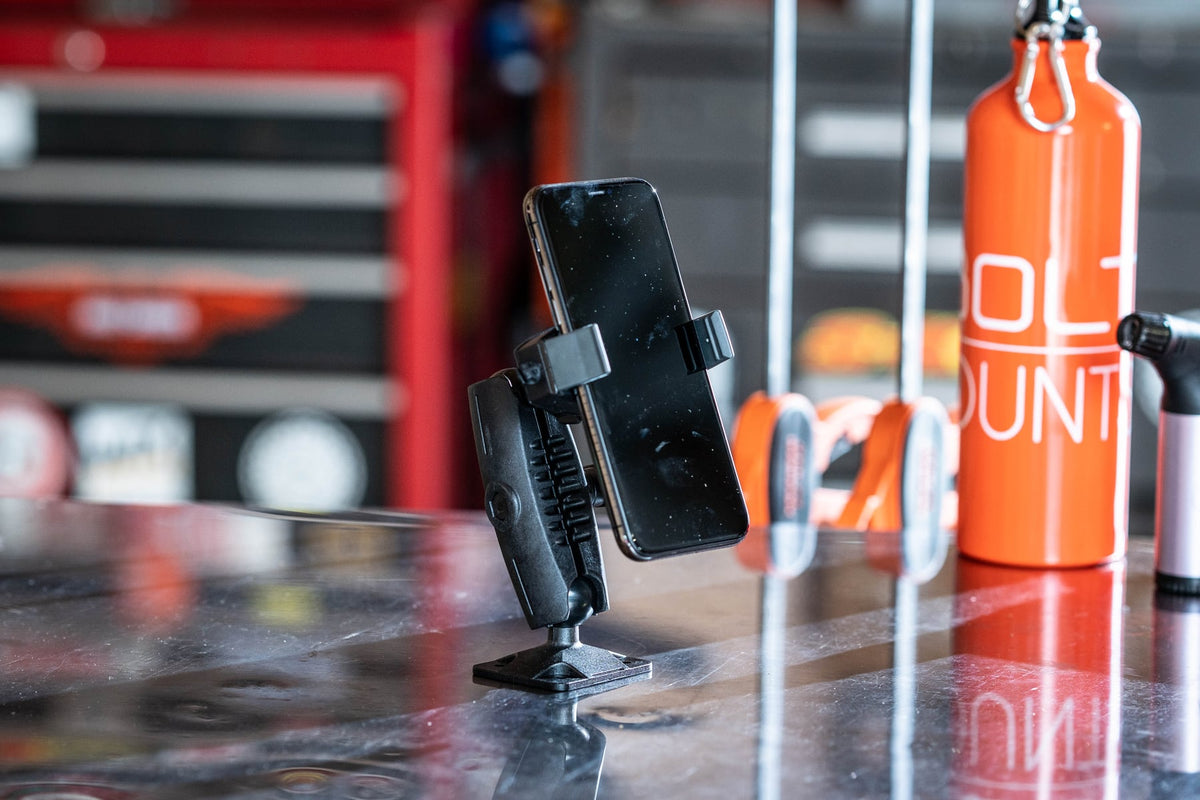
Heat, Dust, and Vibration: Work Truck Phone Mount Fixes
It is 6:15 a.m. and the crew is already staged at the gate. The foreman grabs his phone off the seat, punches in the site address, and props the device against the cupholder because the vent clip snapped off somewhere on a washboard road two weeks ago. That is not a fringe scenario. On construction, utility, oil and gas, and fleet vehicles, standard consumer mounts fail fast and fail often.

Quick answer: The root causes are heat, dust, constant vibration, thick rugged cases, shared drivers, and cable strain. Each one has a specific mounting fix. A drill-base mount with an AMPS pattern footprint, a vibration-dampening ball joint, and a locking cradle solves most of them at once. The sections below break down each cause and the setup that addresses it.
Why Standard Mounts Fail on Work Trucks
Consumer vent clips assume a climate-controlled cabin and smooth pavement. Work trucks offer neither. Cab temperatures in direct sun can climb well above the thresholds that Apple and Samsung flag as problematic for device performance and battery health. Add GPS running continuously, charging active, and a phone sitting in direct sunlight, and heat becomes a real operational problem, not just a comfort issue.
Adhesive pads lose grip when surface temperatures cycle repeatedly. Suction cups fail on textured dashboards common in heavy-duty trucks. Vent clips stress the vent louvers and eventually snap them. None of these bases were designed for the vibration profile of a diesel cab crossing a gravel haul road.
NHTSA and OSHA both frame reaching for a loose or fallen phone as a distraction risk. A mount that stays put is not just a convenience item on a work truck. It is part of a basic safety setup.
Fix by Cause: A Field Decision Table
Use this table to match the problem you are actually seeing to the right mounting approach.
| Environmental Cause | What Fails | Mounting Fix |
|---|---|---|
| Cab heat and direct sun | Adhesive pads, suction cup seals | Drill-base mount away from windshield sun exposure |
| Dust and grit | Suction cup seals, plastic pivot joints | Composite ball joints, sealed cradle hardware |
| Constant vibration | Single-point ball joints, vent clip teeth | Dual ball joint arm with AMPS drill base |
| Thick rugged cases | Spring cradles sized for bare phones | Wide-jaw adjustable cradle or locking dock |
| Shared drivers | Personal preference setups, no standard position | 360-degree multi-angle drill base with locking position |
| Cable strain | Charging ports, cable connectors | Fixed-position dock with integrated or managed cable routing |
Heat and Dust: Get the Mount Off the Dashboard Surface
The single most effective heat fix is repositioning. A mount drilled into the console, transmission tunnel, or a flat panel below the windshield line keeps the phone out of the direct sun zone and away from the dashboard surface that absorbs radiant heat all day. Composite materials in the mount arm also handle temperature cycling better than thin plastic.
The iBOLT 7.45 inch Composite Dual Ball Bizmount with Metal AMPS Drill Base ($48.95) gives you a composite arm with a metal AMPS drill base that bolts directly to any flat surface. The AMPS pattern is an industry-standard four-hole layout, which means the base is compatible with iBOLT's full range of holders and adapters. Dust has fewer moving seals to attack compared to a suction cup assembly.

Vibration: Dual Ball Joints Hold Where Single Points Drift
Diesel engines at idle produce low-frequency vibration that single-point ball joints cannot resist over time. The joint slowly walks out of position, and by the end of a shift the phone is pointing at the headliner. On gravel or off-road access routes, the problem compounds.
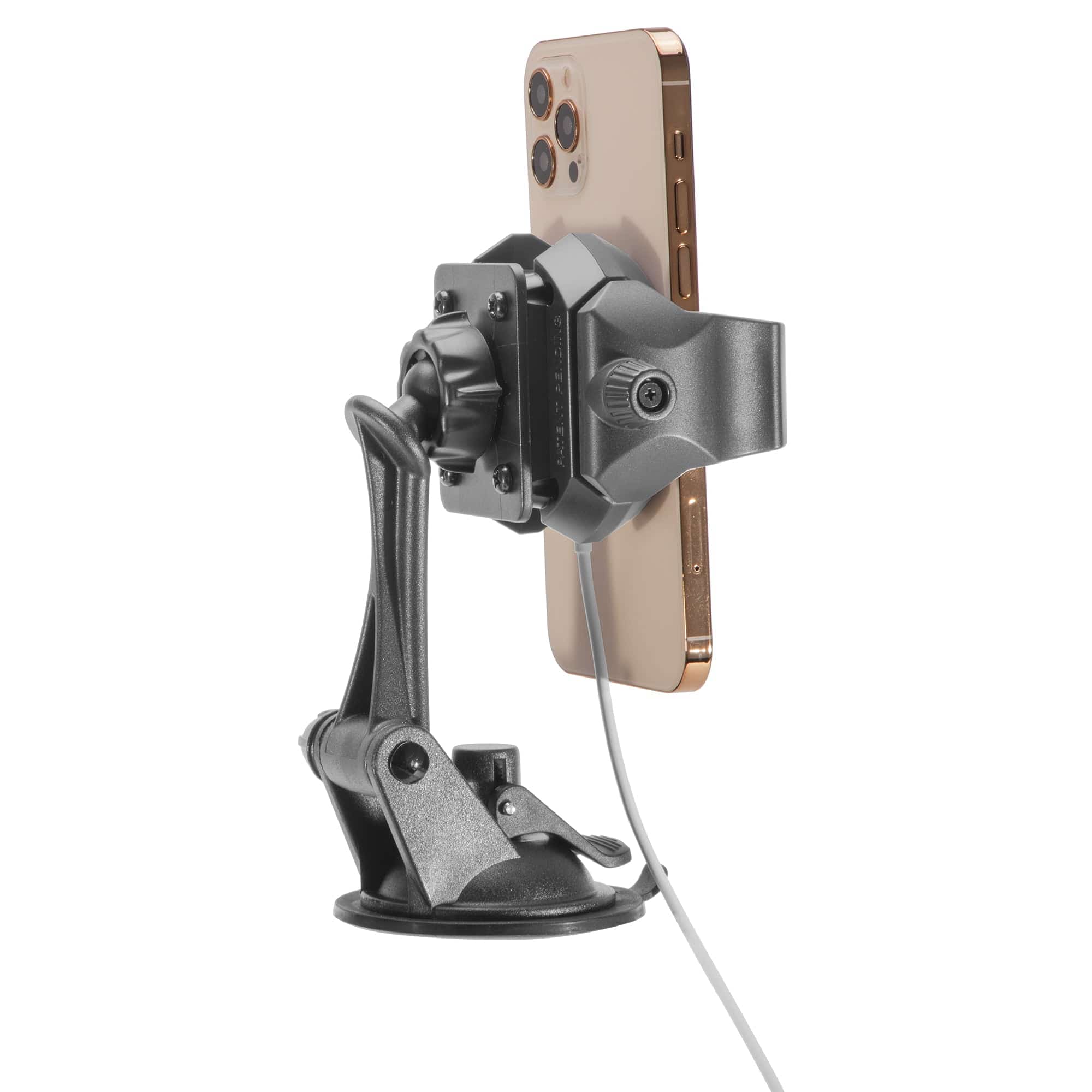
A dual ball joint system distributes the load across two pivot points and holds a set angle more reliably under continuous vibration. The iBOLT xProDock Bizmount AMPS ($39.95) uses a vibration-resistant dual ball joint system paired with an AMPS drill base. One-handed insertion and removal keep the workflow fast when a driver is switching between the cab and the site. It accommodates most smartphones including those in protective cases.

iBOLT™ xProDock™ Bizmount™ Amps - $39.95
Rugged Cases, Shared Drivers, and Cable Strain
Field crews run phones in Otterbox-style cases that add significant bulk. A cradle sized for a bare phone will not close properly around a case, and the phone rattles loose. The fix is a wide-jaw adjustable cradle or a locking dock that physically secures the device regardless of case thickness.
Shared vehicles add another layer. When three drivers use the same truck across shifts, nobody wants to fight with a mount that only works at one angle. A 360-degree multi-angle base with a lockable position lets each driver set the angle they need and lock it down.
Cable strain is the quiet failure mode. A phone that swings freely on a single-point mount pulls the charging cable at an angle every time the truck hits a bump. Over weeks, that stresses the port. A fixed-position locking dock keeps the cable entry point stable.
The iBOLT Phone Dock'n Lock IncrediBOLT 360 ($69.95) addresses all three. It is a locking phone holder on a multi-angle composite drill base with an AMPS pattern footprint. The locking mechanism holds the phone securely regardless of case bulk, the multi-angle base satisfies different driver preferences, and the fixed dock position keeps cable routing consistent. It installs on any flat surface, which means it works in the cab, on a utility body shelf, or on a fleet workstation.

Fleet and Compliance Context
For commercial drivers, FMCSA mobile phone restrictions emphasize hands-free placement as a baseline requirement. A drill-base mount that keeps the phone in a fixed, visible, reachable position supports that placement discipline better than a mount that needs to be repositioned every shift. Fleet managers specifying mounts for multiple vehicles benefit from the AMPS standard: one base pattern works across iBOLT's 300-plus modular parts, so holders can be swapped or upgraded without replacing the entire base.
Frequently Asked Questions
Will a drill-base mount work in a leased fleet vehicle?
It requires drilling into a surface, so check your fleet agreement. Many fleet operators drill into the console or transmission tunnel rather than the dashboard to minimize visible impact.
What is the AMPS pattern?
AMPS is an industry-standard four-hole bolt pattern used across professional mounting hardware. iBOLT's AMPS-compatible bases accept a wide range of holders and adapters, making it easy to reconfigure a setup without replacing the base.
Can these mounts handle phones in heavy protective cases?
The iBOLT xProDock Bizmount AMPS and the Phone Dock'n Lock IncrediBOLT 360 both accommodate most smartphones in protective cases. Check the adjustable jaw range against your specific case dimensions before ordering.
How does a fixed mount help with cable strain?
When a phone is locked in a fixed position, the charging cable enters the port at a consistent angle rather than flexing with every bump. That reduces stress on the port and the cable connector over time.
Do these mounts work outside the cab?
Yes. The drill-base design means they install on any flat surface, including utility body shelves, equipment carts, and workstation panels.
Which mount is best for a multi-driver fleet truck?
The Phone Dock'n Lock IncrediBOLT 360 is a strong fit because the multi-angle base locks into position, so each driver can set a preferred angle and secure it without tools.
See which setup fits your truck and your crew at iboltmounts.com.


Leave a comment
This site is protected by hCaptcha and the hCaptcha Privacy Policy and Terms of Service apply.